 Kitchen Reading
The Same Hibiscus Tea Bag, Hot Under a Saucer or Cold in a Pitcher
Each bag of Traditional Medicinals' organic hibiscus holds 1,260 milligrams of dried red calyces. I brewed a box both ways the label allows, hot under a lid and chilled in a pitcher, and read what each glass holds.

This is a paid advertisement. Sponsored by WorldPantry.com, Inc. (seller, operator of the Traditional Medicinals online store); Traditional Medicinals, maker.

A word on who is talking: Lionel Barrow is a pen name, and the kitchen, the kettle and the neighbors in this story are drawn from many kitchens our writers know.
What this page says about the tea comes from the box, the seller's listing, its return terms and the published studies, all read in September 2026.
There's a red enamel kettle on the back burner of my stove.
It's chipped near the handle, it whistles half a second late, and it has boiled more water than I could ever count.
For most of its life it made coffee in the morning and nothing else.
This summer it picked up a second job.
It started at a cookout on our street, the Saturday after the Fourth of July.
Somebody set a big glass pitcher on the picnic table, and the drink inside was the deepest red I'd ever seen in a glass.
It wasn't punch, and it wasn't wine.
It was tart and cold, with a thin slice of lime floating on top, and it didn't taste of sugar at all.
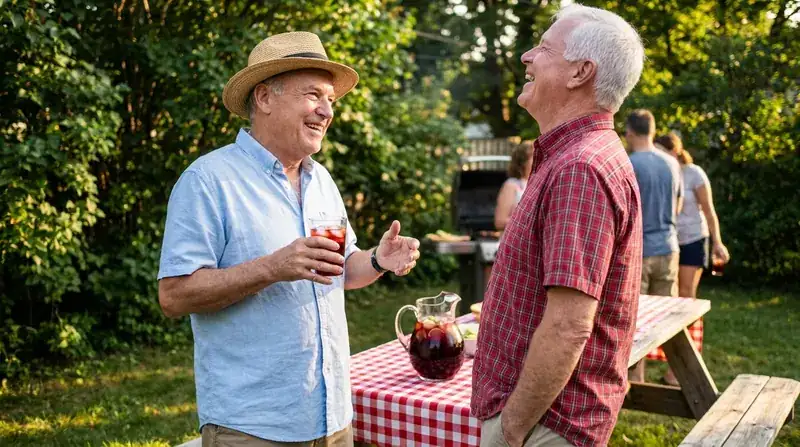
"Agua de Jamaica," said my neighbor across the fence, when I finally asked.
"Hibiscus, water and a little lime. My wife's family has made it every summer of her life."
By the end of the afternoon, the pitcher was empty and the cooler full of soda was still half full.
That doesn't happen at a cookout on our street, and I noticed it.
I went home that evening and did what I usually do when something catches my attention.
I looked it up, and then I kept looking.
It turns out that the same red drink has a different name in almost every warm country that makes it.
It also turns out that one of the most common boxes of hibiscus tea in American grocery stores prints something about the heart on its front.
A drink with three names and one color deserves a closer look.
So what is this page, exactly? It's what I found when I brewed one box of that tea the two ways its label allows.
One cup hot, under a lid, and one pitcher cold, from the refrigerator.
The box is an organic hibiscus tea from Traditional Medicinals, sixteen bags, sold on the brand's own website through a store run by a company called WorldPantry.com.
I'll show you the box itself a little later, once we've talked about the drink.
Along the way, I'll tell you what the published studies of hibiscus measured, in whom, and at what amount.
I'll also tell you, plainly, what those studies don't let anyone say.
This isn't medical advice, and it isn't a verdict.
It's one man's reading of a red cup and a cold pitcher, written out so you can check my work.
A Kettle That Used to Make Only Coffee
I'm sixty-eight, and I've been a coffee man since the Army.
Two cups in the morning, black, from the kettle and a paper filter.
That part of my day works fine, and I'm not here to talk you out of yours.
It's the rest of the day I started thinking about.
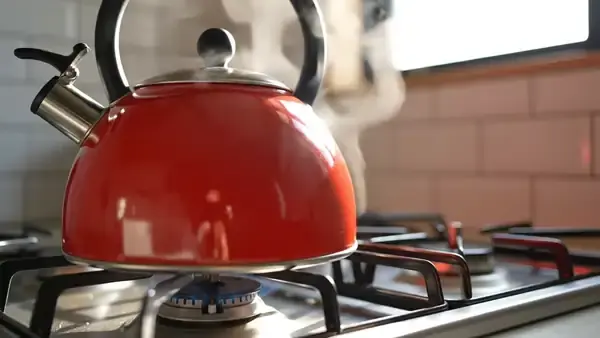
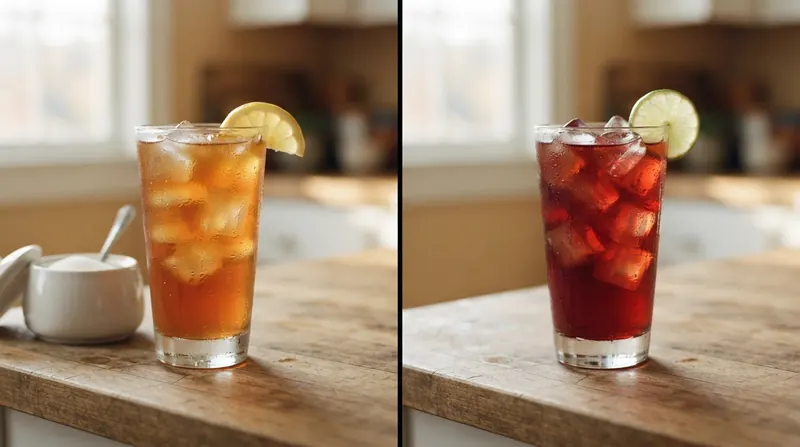
What does your afternoon glass look like? Mine used to be a big glass of sweet tea from the jug in the refrigerator door.
Some days it was a can of soda from the garage fridge, and on hot days it was both.
I never thought of either one as a decision.
They were just what was cold and within reach at three o'clock.
My daughter likes to say I'll drink anything cold if it's standing in the refrigerator door.
She isn't wrong, and that's exactly why what stands in that door matters.
Then, a few summers back, my granddaughter asked me how many spoons of sugar went into that jug.
I measured the next batch as I made it, and I didn't like the answer.
Here's the thing about a daily habit.
One glass doesn't matter much, but a glass every afternoon for a year is three hundred sixty-five glasses.
A habit is just a small choice you've stopped noticing.
So I started looking for a replacement.
Something cold, something with real flavor, and something without a pile of sugar in it.
I also wanted it to be something I'd actually look forward to.
I know myself, and plain good intentions don't last past the middle of July.
That's how a red kettle that used to make only coffee ended up boiling water for hibiscus.
And that's how I ended up reading the fine print on a sixteen-bag box, line by line, at the kitchen table.
The Three O'Clock Glass
Let's start with the problem, because it's a common one.
It isn't a scary problem, and it isn't a medical one.
It's simply that most of us reach for the same afternoon drink every day without thinking about it.
For a lot of men, that drink carries more sugar or more caffeine than they'd ever choose on purpose.
What do the federal guidelines actually say about drinks? The Dietary Guidelines for Americans, 2025–2030, say to choose water, still or sparkling, and unsweetened drinks. [1]
They also say to avoid sugar-sweetened drinks such as sodas, fruit drinks and energy drinks, and to keep juice to small portions or dilute it with water. [1]
They add one number that's easy to remember: no more than 10 grams of added sugar in any one meal. [1]
Measure the sugar that goes into your own jug, or read the side of the can, and you'll see how quickly a single glass gets there.
And the energy drinks? A 16-ounce energy drink can carry 70 to 240 milligrams of caffeine and 54 to 62 grams of added sugar. [2]
In some cans that's more caffeine than two 8-ounce cups of coffee, and five or six meals' worth of that sugar limit in one sitting. [2]
What about a fourth cup of coffee? The FDA cites 400 milligrams of caffeine a day, about two to three 12-ounce cups, as an amount not generally associated with negative effects in most healthy adults. [3]
Past that, too much can bring jitters and an upset stomach, which is one reason a lot of men stop the coffee at noon. [3]
Is sweet tea really so bad? It's a fine drink at a picnic, and I'm not going to pretend otherwise.
The trouble is the daily glass, because the sugar in a jug adds up the same way whether you notice it or not.
None of that makes coffee the villain, or sweet tea, for that matter.
It just means the afternoon slot is the one most of us fill on autopilot.
So why not just drink water? You should, and so should I.
The same guidelines put water at the top of the list, still or sparkling. [1]
Water wins on paper. The trouble is that paper isn't thirsty at three o'clock.
Why Plain Water Doesn't Always Win
I tried the water-only plan, the way a lot of men do after one honest look at the sugar in the jug.
It lasted about nine days.
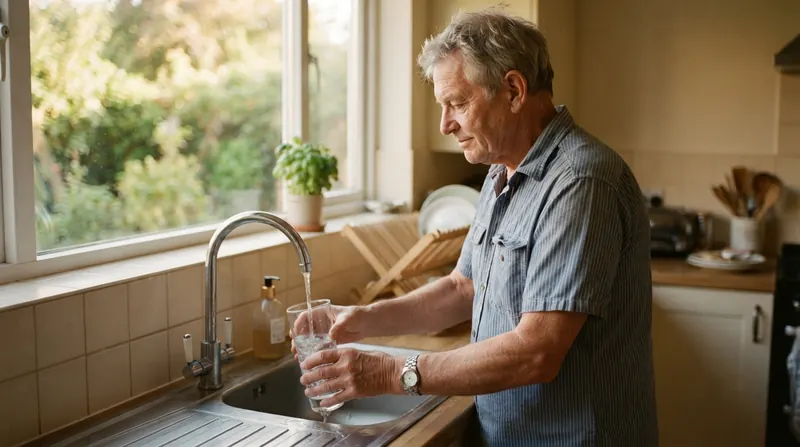
Why do good habits fade so fast? Mostly because they're dull.
A habit that feels like a chore has to be defended every single day, and sooner or later you get tired of defending it.
The habits that last are the ones you'd pick even if nobody told you to.
Your morning coffee lasts because you like it, not because you promised anybody.
What about the flavored waters? Plenty of men land there, and I understand why.
To me they tasted like a rumor of fruit, and I wanted a drink that tasted like something.
I also wanted something I could make myself, in my own kitchen, in a quantity I could see.
There's something about a pitcher you brewed that makes you want to finish it.
So the question I ended up asking wasn't "What should I drink?"
It was "What would I actually reach for, cold, at three o'clock, without a spoonful of sugar or another round of caffeine?"
- It had to be cold, because summer afternoons are long.
- It had to taste like something, tart or bright, not like a wet paper towel.
- It had to work without sugar, or at least without much.
- It had to skip the caffeine, because two cups in the morning is my limit.
- It had to be cheap enough to drink every day without doing math about it.
That's a short list, and a surprising number of drinks fail it.
The red drink from the cookout passed all five, at least on the first afternoon.
Isn't it just another fad from the grocery aisle? Not by a long shot.
People have been making it, hot and cold, for generations, in a lot of places a long way from my street.
Agua de Jamaica, Karkade and Sorrel
The plant behind the red is a hibiscus called roselle, a member of the mallow family.
It's likely native to parts of Africa, and it was carried to Asia and the West Indies in the 16th and 17th centuries.
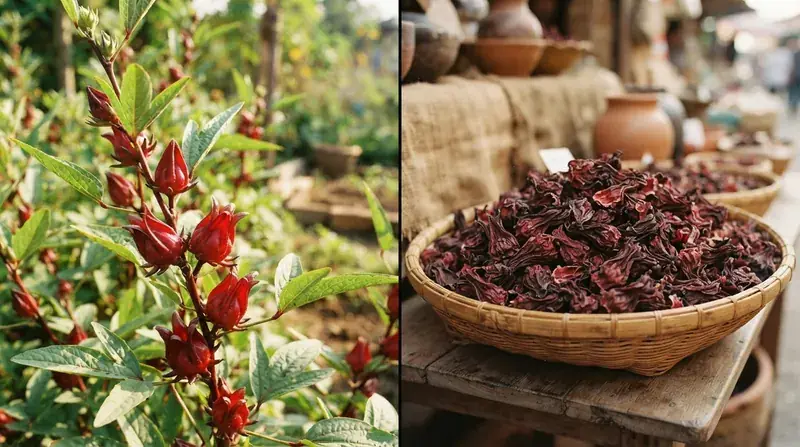
Which part goes into the drink? Not the flower's petals, which is what most people picture.
It's the calyx, the fleshy red cup that wraps around the seed pod, dried and then steeped.
Its color comes from two red pigments called anthocyanins, and its tartness comes from a group of fruit acids, one of them called hibiscus acid. [4] [5]
If you've ever puckered at a glass of it, that's what you tasted.
Where do people drink it? Almost everywhere it's warm.
In Mexico, Central America and Colombia it's agua de Jamaica, one of the cold agua fresca drinks.
In Sudan and Egypt it's karkade.
In much of the English-speaking Caribbean it's sorrel, and here at home some people still call it Florida cranberry or Jamaica sorrel.
A 2014 review of the plant describes it the way the neighbors do: a food, a hot drink, a cold drink and a flavoring. [4]
That same review found an excellent record of safety and tolerability, and said better controlled trials were still needed. [4]
Why should that matter to you? Because a drink with that kind of history isn't a lab invention looking for a customer.
It's a kitchen drink that happens to come in tea bags now.
My neighbor's wife makes hers from loose dried calyces, and she makes it strong.
She buys them by the bag at a grocery a couple of towns over, and she measures by the handful.
Does it matter which name you use? Not to the plant.
But all those names tell you the same thing: it has been a hot drink and a cold drink in a lot of kitchens for a long time. [4]
Most of us, though, are going to buy it the way we buy everything else.
In a box, at the grocery store or online, with sixteen bags inside and a list of ingredients on the side.
The drink is old. The tea bag is the only new part.
There's one more thing about her pitcher, though, and it's the question this whole page turns on.
She never boils anything.
Sixteen Minutes Hot, Four Hours Cold
She drops a couple of handfuls of dried calyces into a big jar of cold water in the morning and leaves it on the counter until the afternoon.
By three o'clock it's as red as anything I've ever brewed in the kettle.
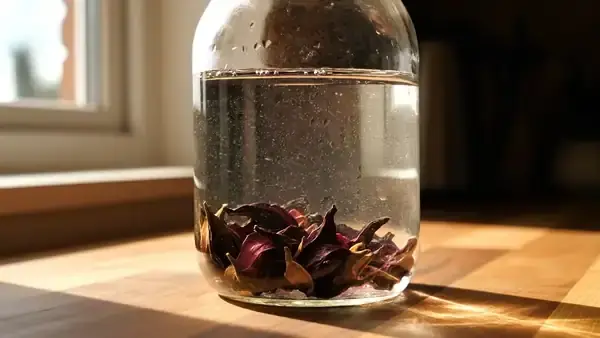
So is the cold version weaker? That was my first thought, standing in her kitchen with a glass in my hand.
It turns out a group of food scientists asked almost the same question in 2011, and they measured the answer. [5]
They steeped hibiscus calyces in cold water and in hot water, then measured what came out into each. [5]
The cold water was about room temperature, 25 degrees Celsius, and the hot water was 90 degrees, just short of boiling.
Here's the result that matters in a kitchen.
The cold water needed 240 minutes to draw out the same amount of red pigment that the hot water drew out in 16 minutes. [5]
Four hours cold, sixteen minutes hot, and the same red in the glass.
So there's no difference at all? There are two, and both are worth knowing.
The hot water drew out more of the other plant compounds, the ones called phenolics, and more antioxidant capacity in the test tube. [5]
The cold extracts, on the other hand, kept their color better. [5]
Both versions carried the hibiscus acid and the two main red pigments. [5]
What does "antioxidant capacity in a test tube" mean for you? Honestly, not much by itself.
It's a laboratory measurement of the liquid, not a measurement of anybody who drank it.
And does that study match a tea bag? Not exactly, and I want to be fair about it.
It used fresh and dried calyces in a laboratory, not commercial tea bags, and it timed the steeping differently from any box I've seen.
But it settles the argument across the fence.
My neighbor's wife isn't making a weaker drink, she's making a slower one, and her color holds up better in the jar.
And the kettle isn't wasted effort either.
Hot water gets the red out in a fraction of the time, and it pulls a little more of everything else along with it.
Of course, I had to see it for myself.
My neighbor's wife gave me a handful of her dried calyces in a sandwich bag, with instructions I wasn't allowed to write down.
I split them into two equal piles on the counter.
One pile went into a quart jar of cold tap water at nine in the morning, and the other waited for the kettle.
At about twenty to one, I poured just-boiled water over the second pile in a matching jar and set the kitchen timer for sixteen minutes.
Then I lined the two jars up on the windowsill, side by side, with the light coming through them.
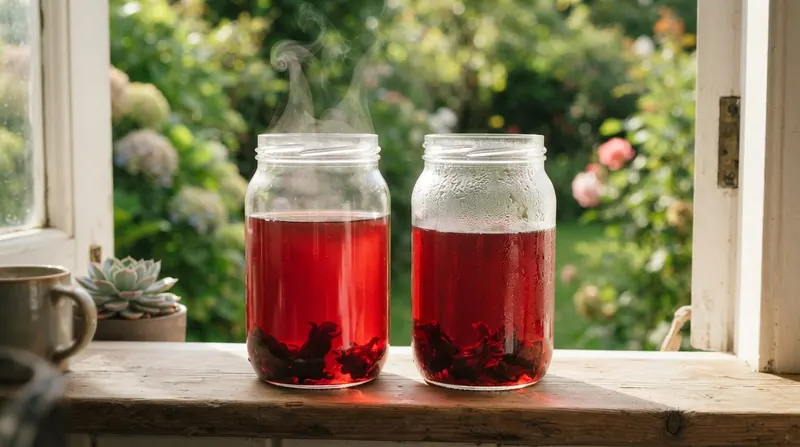
Could I tell them apart? Not by color, honestly, at least not at first glance.
Both were the same deep, see-through red, like a stained-glass window with the sun behind it.
By taste, I thought the hot jar was a shade sharper and the cold one a shade smoother.
My neighbor, who tasted both without knowing which was which, picked the cold one as hers, which pleased her a great deal.
That's one kitchen and two jars, not a study.
But it lined up with what the scientists found, and it made their numbers feel real.
Cold is patient and hot is quick. The red ends up in the glass either way.
Keep that in mind, because the box I bought has its own answer to the hot-or-cold question.
It's a sensible one, and we'll get to it right after we look at what the red actually is.
What the Red Is Made Of
What gives the drink its color? Two red pigments, both anthocyanins, with long names: delphinidin-3-sambubioside and cyanidin-3-sambubioside. [4]
You don't need to remember them, but it's nice to know the red has a name.
The same family of pigments colors a lot of red and purple foods.
In hibiscus, the 2014 review names those two as the main ones. [4]
And the sour taste? That's the fruit acids, including hydroxycitric acid and hibiscus acid, along with plant acids called phenolic acids. [4]
The review singles out one of those, protocatechuic acid, as especially prominent. [4]
Is that why it makes your mouth pucker? Yes, the same way a lemon or a cranberry does.
It's also why some people who say they don't like hibiscus really mean they don't like sour.
Does the body hold on to the red? Very little of it, in its original form.
In six healthy volunteers who drank a hibiscus extract, only about 0.018 percent of the red pigments showed up intact in the urine within seven hours. [6]
In their blood, those pigments peaked about an hour and a half after drinking, with half-lives of roughly two to three and a half hours. [6]
That study counted the pigments in their original form, not what the body turns them into, so it tells only part of the story. [6]
Is there anything else in the research? One small study looked at a single serving. [7]
Eight healthy volunteers drank a water-based hibiscus extract, and their blood's antioxidant capacity rose compared with a glass of water. [7]
Their urine also carried more hippuric acid, a breakdown product of plant compounds that the authors attribute mostly to gut bacteria. [7]
That's a laboratory marker in eight people on one day, not a health outcome, and I'd be misleading you if I dressed it up as more.
Why go into all this chemistry? Because the red is the first thing anyone notices, and it's easy to assume the color itself is doing something.
It's a pigment, and a beautiful one, and what the research says about it is exactly as modest as I've described.
The red is real chemistry. It isn't a promise.
So now you know what the red is, how it gets into the water and how little of it stays in its original form.
Here's the box that puts it in a bag.
The Box on My Counter
I bought my first box at the grocery store and my second on the brand's website.
Here it is, the way it sat on my counter for most of a month.
What's actually in a bag? Two lines on the panel, and that's all.
The first line is 1,260 milligrams of organic hibiscus calyces, the dried red cups we just talked about.
The second line is 490 milligrams of a blend of organic blackberry leaf and organic West Indian lemongrass.
The panel doesn't say how that 490 is split between the two, and I'll come back to that.
Add the two lines together and every bag holds 1.75 grams of dried plant, and the box of sixteen comes to a net weight of 0.99 ounces, or 28 grams.
The panel lists zero calories, and the front of the box says plainly that there is no caffeine.
All the ingredients are certified organic, with the USDA Organic seal on the front, and the store labels the tea Fair Trade.
The box calls itself an "Herbal Supplement," which is the legal category it's sold under, not a description of how it tastes.
What does the front say about the heart? In a green band across the middle, it prints three words: Promotes Heart Health.*
That asterisk matters more than the three words.
It's the legal signal that the sentence hasn't been evaluated by the Food and Drug Administration, and you'll find the full statement at the foot of this page.
Has this tea itself been tested? No, not this box and not this blend.
And there's one more thing I want to say plainly, before we go any further.
Some hibiscus trials measured a reading your clinician takes at a checkup.
I don't cite them here, because this page is about a cup of tea, and a cup of tea shouldn't be sold as a number.
What this page can honestly offer is the drink, the plant, the chemistry and the habits around it.
That turns out to be plenty.
Let's start with what each of the three plants in the bag is doing there.
Three Plants, and What Each One Is Doing in the Bag
Why hibiscus? For the color and the tartness, first of all.
It's also the only line on the panel with its own number, 1,260 milligrams, which makes it the backbone of the cup.
We've already met its chemistry: fruit acids for the pucker and two red pigments for the color. [4]
That's what the box means when it prints "Tart & Fruity" under the name.
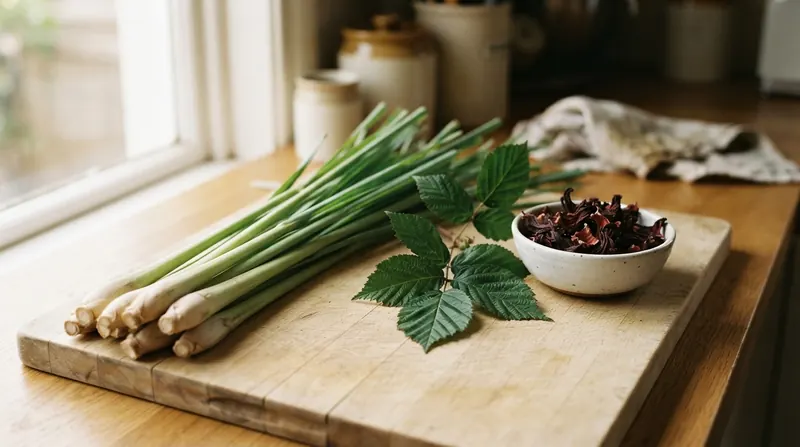
Why blackberry leaf? It comes from the blackberry bramble, a thorny cane of the rose family.
People have brewed blackberry leaves, stems and bark at home for centuries, and an 18th-century document describes it.
The fruit, leaves and stems have even been used to dye fabric and hair.
I found no study of blackberry leaf for the heart, the circulation or everyday energy, so I'll take it for what it is here: part of the flavor.
And lemongrass? It's a tall tropical grass native to South Asia and Maritime Southeast Asia, and it's grown across the tropics.
Its dried leaves brew into something that tastes like lemon juice, with a mild sweetness and not much sourness.
Across Southeast Asia it's an everyday kitchen herb: sereh or serai in Indonesia and Malaysia, takhrai in Thailand, tanglad in the Philippines.
In this bag, it rounds off the sharp edge of the hibiscus.
So two of the three plants are there for taste.
That isn't a knock on the box, it's the honest description of a good-tasting tea.
One plant for the color, two for the flavor. That's the whole bag.
What about the blend with no split? It's common on tea boxes, and it's worth knowing about.
The 490 milligrams could be mostly blackberry leaf or mostly lemongrass, and the label doesn't say which.
For a flavor blend, that's a small thing.
For the hibiscus, which does carry its own number, the label is complete.
One more detail, from the ingredient card on the brand's website: it lists the part used as the calyces, while the listing says "hibiscus flower."
They mean the same plant, and calyx is the right word for what's in the bag.
The Box's Way: Hot First, Then Into the Refrigerator
Now for the part that started this whole page: the lid.
The box tells you to pour eight ounces of freshly boiled water over one bag, then "Cover & Steep for 5-10 min."
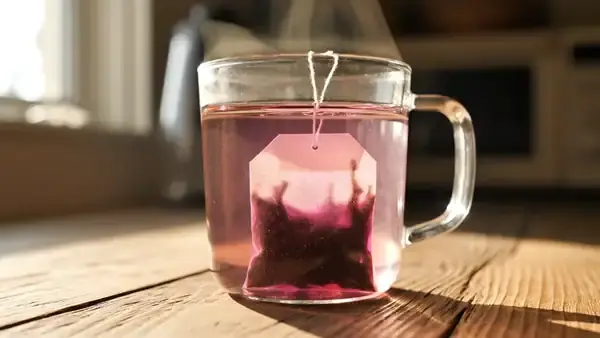
Why cover the cup? The box doesn't explain, but a lid keeps the steam and the heat in the cup instead of letting them drift off into the kitchen.
I use a small saucer, which is what my mother used, and it works fine.
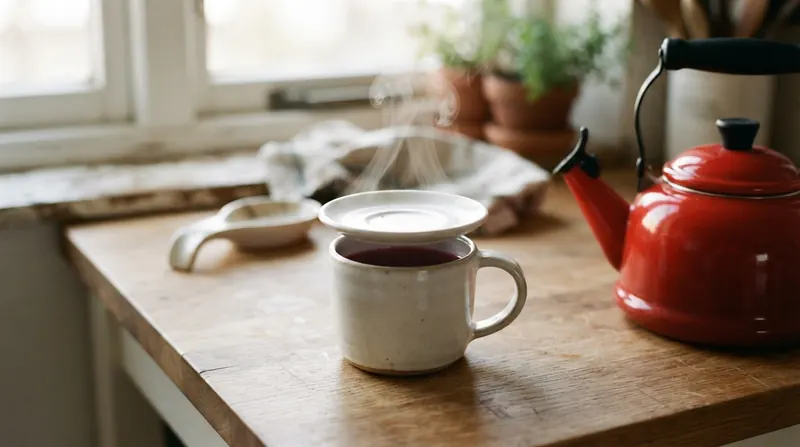
Then what? You lift the saucer, and the box says to squeeze the bag to get the most out of it.
I press mine against the side of the mug with the back of a spoon.
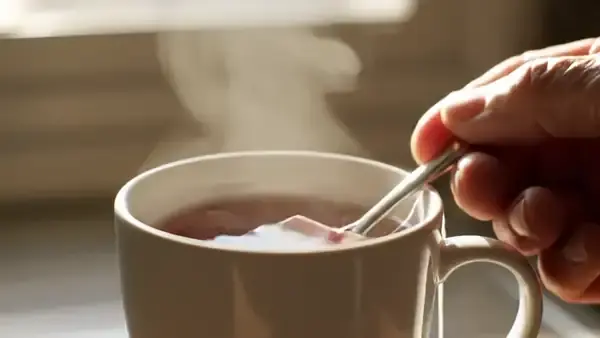
And the iced version? The box is specific about that, too.
You brew it hot exactly the same way, put the cover back on, and chill it in the refrigerator before adding ice.
It also says to keep it chilled and drink it within 24 hours.
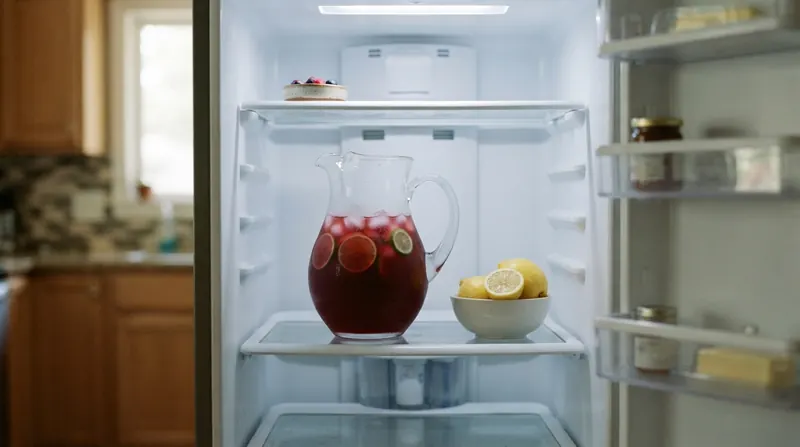
So a pitcher is a one-day thing, not a week's supply, and I brew mine in the morning for the same afternoon.
Why brew it hot if cold works? Think back to the laboratory study.
Hot water gets the red out in sixteen minutes instead of four hours, and it draws out more of the other plant compounds while it's at it. [5]
The box's method takes that quick hot extraction and then gives it the cold glass anyway.
It's the kettle and the pitcher in the same jug, which is exactly the argument across the fence, settled.
The box's way isn't a compromise. It's the hot cup and the cold pitcher in one jug.
My neighbor's wife still does it her way, cold and slow, and hers is gorgeous.
Mine, brewed hot under the saucer and chilled until the afternoon, is just as red and, to my taste, a little more tart.
How Much Hibiscus Is in a Day of Cups
The box suggests three to four cups a day.
At 1,260 milligrams per bag, that's about 3.8 to 5 grams of dried hibiscus between breakfast and supper.
Is that a lot? It's in the same range as the one study I could find that gave healthy people a daily amount of roselle tea for a month.
That study was small, and it had a real limitation, so let me tell you exactly what it was.
In Indonesia, 30 healthy adults aged 24 to 56 drank 200 milliliters of roselle tea every morning and every evening for 30 days. [8]
Each glass was brewed from about 2 grams of dried calyces, so a day came to roughly 4 grams. [8]
The researchers ran fitness tests, but there was no comparison group, so the study can't tell anyone what the tea itself did. [8]
The authors list the small sample and the missing comparison group among its limits themselves. [8]
So what does that study tell you? Mostly the amount.
Two glasses a day of home-brewed roselle came to about the same hibiscus as three to four bags from this box.
That's useful as a yardstick, and nothing more.
A month of practice, a change of season or simple enthusiasm can move a fitness test just as easily as a drink can.
Is three to four cups a day too much? The 2014 review describes hibiscus as having an excellent record of safety and tolerability. [4]
That's reassuring, and it's also the kind of sentence that deserves its small print.
One preliminary study found that 16 days of drinking a hot hibiscus infusion raised the aluminium people passed in their urine, irregularly. [9]
Some of the more sensitive volunteers reported mild nausea and dizziness, and the authors advised pregnant women to be careful with large amounts. [9]
The box itself asks you to check with your healthcare practitioner first if you're pregnant or breastfeeding.
And if you take anything daily, show the box to your pharmacist before your first cup.
Three or four cups is the label's number. Your pharmacist gets the last word on yours.
What the Evidence Lets Me Say, and What It Doesn't
Let me put the honest version in one place, because it's easy to lose in the details.
Here's what the evidence I've read supports.

- The tea is tart, red and fruity because of fruit acids and two red pigments. [4]
- Cold water can pull the same red out of hibiscus as hot water, given about four hours instead of sixteen minutes. [5]
- Hot water draws out more of the other plant compounds, and the cold cup keeps its color better. [5]
- Very little of the pigment reaches the blood intact, and what does peaks about an hour and a half after drinking. [6]
- One serving raised a laboratory marker in eight people on one day. [7]
- Hibiscus has a long history as a food and drink, and a 2014 review found an excellent record of safety and tolerability. [4]
And here's what that evidence doesn't support.
Anything about a reading your clinician takes, anything about how you'll feel, and anything about this particular box, which has never been studied.
Then why drink it at all? Because of the part that's true for any unsweetened drink you actually enjoy.
The federal guidelines say to choose water and unsweetened drinks, and to avoid sugar-sweetened ones. [1]
A glass of this tea, brewed and chilled without sugar, is an unsweetened drink with zero calories on the panel.
If it takes the place of the sweet tea or the soda, that swap is exactly the one the guidelines recommend.
The benefit you can count on isn't in the bag. It's in what the glass replaces.
Isn't tea good for circulation? That's a common idea, and it deserves a careful answer.
It comes mostly from black and green tea, which are a different plant altogether.
In 21 healthy women, both green and black tea made the arm artery widen more easily two hours after drinking than water did. [10]
A review of nine studies found the same direction at about two to three cups a day, with results that varied widely, and all three of its authors worked for a company that sells tea. [11]
Hibiscus wasn't part of those studies.
So I won't borrow their result for a red cup, and I'd ask the box not to lean on it either.
What does count, then? The American Heart Association's own scoring system is a good map.
It scores eight things: four daily habits, among them diet, activity and staying away from nicotine, and four measurements that are best checked with a clinician. [12]
A cup of tea is a small part of one habit on that list, the diet.
The four measurements belong to your yearly visit, and no box of tea, including this one, can stand in for it.
A Day With the Kettle and the Pitcher
Here's what a normal day looks like around my kitchen now.
It isn't a program, and nothing in it is hard.
Morning. Two cups of coffee, black, same as always.
Then the kettle goes back on for the day's hibiscus.
One bag goes into a mug with the saucer on top, for drinking hot while I read the paper.
Two more go into a heatproof jug with sixteen ounces of just-boiled water, covered, for the afternoon.
When they're done, the squeezed bags come out, the lid goes on the jug, and the jug goes into the refrigerator.
Total effort, about two minutes, most of it waiting for the whistle.

Mid-morning. A walk, about twenty minutes, around the long block and past the school.
The federal activity guidelines say bouts of any length count, and they use a 20-minute walk as their own example of a daily goal. [13]
Over a week, they suggest 150 to 300 minutes of moderate activity like brisk walking, plus muscle-strengthening on two or more days. [14]
For older adults, they add balance work, with the effort set by your own fitness rather than anyone else's. [15]
How brisk is brisk? The CDC's rule of thumb is the talk test: you can talk, but you can't sing. [16]
In healthy adults aged 61 to 85, a pace of about 100 steps a minute marked the start of moderate intensity. [17]
I don't count steps on the walk.
But I notice that I can talk to the neighbor's dog, and I definitely can't sing to it.

Three o'clock. This is the slot the whole thing was for.
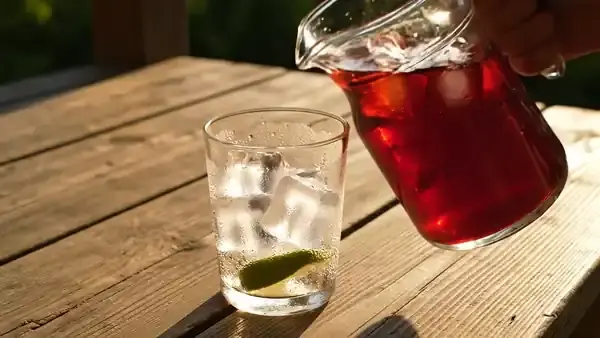
A tall glass of the cold red tea over ice, on the porch if it's nice, with whoever wanders over.
Supper. Nothing fancy, but more vegetables on the plate than there used to be.
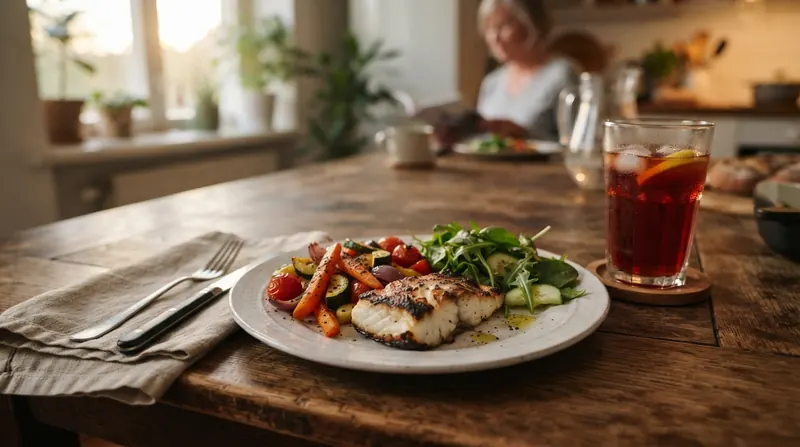
The same dietary guidelines set a goal of three servings of vegetables and two of fruit a day, eaten whole, and they name olive oil, fish, nuts and seeds among the healthy fats. [18]
I also started reading the sodium line on the cans and boxes.
Americans eat about 3,400 milligrams of sodium a day on average, against a limit of less than 2,300, and more than 70 percent of it comes from packaged and prepared food. [19]
On a label, 5 percent of the Daily Value or less per serving is low, and 20 percent or more is high. [19]
The tea's panel, for what it's worth, has no sodium line at all.
Evening. Whatever's left in the jug gets finished, because the box says 24 hours.
Then the jug gets rinsed, and tomorrow's bags go on the counter next to the kettle.
Put like that, the tea is the smallest thing on the list.
It's also the one that made the rest of the list easier, because it gave the afternoon something to look forward to.
Four Habits That Cost Nothing
Since we're being honest, let me put the tea in its place.
Everything in this section matters more than anything in a tea bag, and none of it can be sold to you.
The first is the walk. It's already on the refrigerator door, and it's the one I'd keep if I could keep only one.
Some physical activity is better than none, the guidelines say, and you can build toward the weekly range a little at a time. [14]
They suggest a practical way to do it: set a time goal first, and add a 20-minute walk to an ordinary day. [13]
They also point out that 10,000 steps a day is popular advice, not a guideline, which I found a relief. [13]
The second is the salt shaker's bigger cousin, the packaged shelf. Sodium limits apply to everyone 14 and older, not just to men past sixty. [20]
The guidelines advise avoiding highly processed foods that are salty or sweet, such as chips, cookies and candy. [20]
The third is potassium, from food. The adequate intake is 3,400 milligrams a day for men, and the list of foods that carry it is long and ordinary. [21]
Beans, lentils, tomatoes, potatoes with the skin, sweet potatoes, winter squash, bananas, cantaloupe, citrus, milk, yogurt, nuts and fish are all on it. [21]
That same source says to talk with a provider before taking a potassium supplement. [21]
Food first, in other words, and ask before anything in a bottle, especially if you take anything daily.
The fourth is what you drink after supper. The guidelines advise drinking less alcohol for better overall health. [1]
They also say it should be avoided entirely by people who take anything daily that can interact with it. [1]
The walk, the label, the plate and the glass after supper. None of them comes in a box.
Where does the tea fit, then? Right next to the plate, as one pleasant, unsweetened drink.
It's a small habit that makes the afternoon easier, and that's all I'm asking of it.
Who This Box Is For, and Who Should Pass
Who's it for? A man who wants a cold afternoon drink with real flavor and no sugar in it.
Somebody who likes tart things, the way some people like lemonade without the sugar, or cranberry, or a sour cherry.
- You like iced tea and you'd like a version without caffeine.
- You're trying to step away from sweet tea, soda or energy drinks in the afternoon.
- You enjoy a hot cup later in the day, after the coffee is done.
- You like a small daily ritual: a kettle, a lid and a few minutes of waiting.
- You'd rather drink something red and tart than swallow another capsule.
Who should pass? Anyone who doesn't like tart flavors, for a start.
One reviewer I'll quote in a moment says plainly that she doesn't like the taste, and I respect that.
- You want a drink that tastes sweet on its own, without adding anything.
- You're pregnant or breastfeeding and haven't checked with your healthcare practitioner, as the box asks.
- You take anything daily and haven't shown the box to your pharmacist yet.
- You're expecting a number at your next checkup to change because of a tea.
That last one is the most important.
If a number at a checkup is on your mind, the person to talk to is your clinician, and the tea can wait.
Fair Questions About Price, Taste and Time
What does it cost? When I checked, the store listed the box of sixteen bags at $7.49, which works out to about 47 cents a cup.
There was also a 3-pack for $20.97 and a 6-pack for $41.94, plus a subscription option.
How long does a box last? That depends on you, and here the label's own advice matters.
At three to four cups a day, sixteen bags last four to five days, which is closer to $1.40 to $1.90 a day than 47 cents.
At one or two tall glasses a day, a box lasts a week or two.
The 6-pack brings the price per bag down a little, to about 44 cents.
And shipping? On the brand's own store, orders of $45 or more ship at no charge to the 48 contiguous states, usually in one to three days.
Below that, shipping was $8.95 up to $30 and $9.95 from there to $45, and there's a $1.49 fuel surcharge on every order.
Alaska and Hawaii add $15, and the store doesn't ship to PO boxes, military addresses or outside the United States.
You may also find the same box at a grocery store, which is where I bought my first one.
What does it taste like? Tart, first of all, with a fruity, almost cranberry edge and a lemony finish from the lemongrass.
Hot, it's sharper, and iced, it's rounder and more like something you'd pour for company.
Can I sweeten it? You can, and one reviewer adds honey or monk fruit before she chills it.
Just know what the spoon carries: a tablespoon of honey weighs 21 grams, and most of that weight is fructose and glucose. [22]
By the government's own food tables, that's about 16 grams of sugar in one tablespoon. [22]
That's more than the guidelines' 10-gram limit for added sugar in a whole meal, from a single spoon. [1]
A teaspoon stirred into a whole pitcher is a very different thing from a tablespoon in every glass.
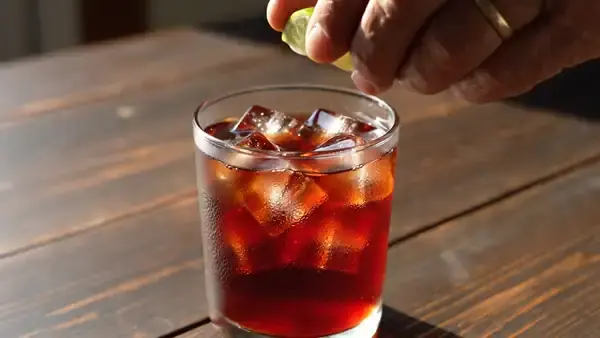
My own answer has been lime, and after a week I stopped missing the sugar.
How much time does it take? Five to ten minutes of steeping for a hot cup, and a few hours in the refrigerator for a pitcher.
The actual work is about two minutes, and most of that is waiting for the kettle.
Loose calyces or bags? Loose calyces, the way my neighbor's wife buys them, let you make it as strong as you like.
One reviewer who made agua de Jamaica from these bags says she got the strength she wanted but needed more bags than she was used to.
The Store's Promise, in Its Own Words
What if you don't like it? WorldPantry.com, which runs the brand's online store, has a satisfaction policy that's easy to read.
If you're not satisfied with a purchase, for any reason, you let them know, and they replace the item or refund its purchase price.
Requests have to be made within 90 days, and the policy covers purchases made through that website only.
Shipping charges aren't refunded unless the store made the mistake.
Is that unusual? For a $7.49 box of tea, a 90-day window is generous.
It also means the cost of finding out is small, which is exactly how a first box of anything should feel.
The maker, Traditional Medicinals, is based in Sebastopol, California, and the store's order line is 765-305-5638.
The store's address and contact details are at the foot of this page, too.
A Month of Pitchers, and What It Taught Me
I kept the pitcher going for most of a month before I sat down to write this.
Nothing remarkable happened, and I didn't expect anything to.
What I learned was practical, the kind of thing you only find out by doing it.
Here it is, in case it saves you a week.
- Brew in the morning, not at three o'clock, or the pitcher won't be cold when you want it.
- Two or three bags make a small jug; more bags make it stronger, the way my neighbor likes it.
- Keep lime in the house, because it's the easiest way to round off the tartness.
- Don't sweeten the whole pitcher; if you want sugar, add it by the glass and measure it.
- Finish it within the day, like the box says, and start fresh in the morning.
- Keep the saucer next to the kettle, because a lid you have to look for is a lid you skip.
Did it replace the sweet tea? Most days, yes, and that was the whole point.
Some days I still reach for the old jug at a birthday or a cookout, and that's fine.
Did I notice anything in my body? I'm not going to answer that one, and I'd be suspicious of anybody who did.
A month of one man's afternoons can't tell you anything about a drink, and it shouldn't.
What I can tell you is that the afternoon glass stopped being something I didn't think about.
It became something I made on purpose, and that turned out to be the habit worth keeping.
A habit you make on purpose is a different habit from one you fall into.
What Other Buyers Wrote
I always read the reviews last, after the panel and the studies.
They're the part of the story written in other people's words.
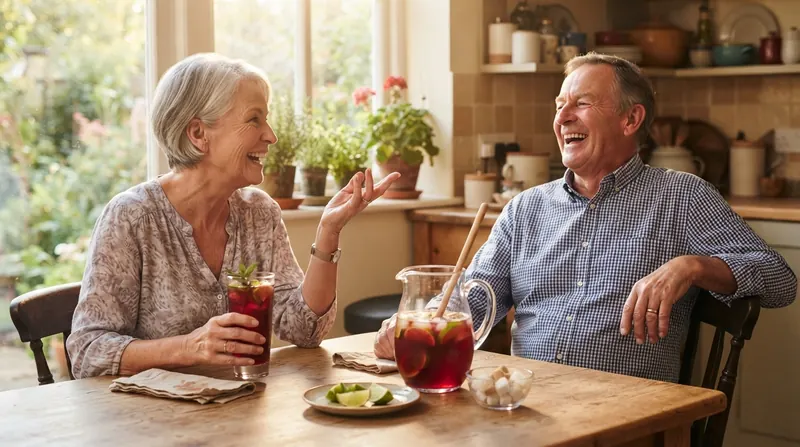
How many reviews are there? When I read the brand's page, the tea had 82 ratings averaging 4.73 stars.
Sixty-two were five stars, eighteen were four, two were three, and there were no ones or twos.
Were they confirmed buyers? The store's review system gives each of the seven below its confirmed-purchase mark.
Many of the reviews from 2021 on that page came from a sample program, and one of the seven below says so at the top of her review.
Here they are, word for word, including a four-star and a three-star.
They're opinions, not evidence, and the small pictures beside them are illustrations, not the reviewers.

This is my husband's favorite herbal tea, he appreciates the very strong hibiscus flavor.

Makes a gorgeous bright red cup of tea that is tart, fruity and refreshing. We can't wait to steep pitchers of this tea to enjoy on ice while kicking back in the hammock with a good book when summer comes.

We love the Hibiscus Tea. We make it all summer long and enjoy it iced.

Its good hot but I usually add honey or monk fruit let it chill and put it on ice

love this robust and colorful tea!

I used my Organic Hibiscus Tea bags to make agua de Jamaica and found that while I was able to get the desired strength, it took more bags than I'm used to. The taste did not come through as too artificial (as can be the case for cheaper teas) and was perfect for the drink I was making. Curious to see how the other flavors compare. Gets the job done and good price point - I'd recommend this to anyone looking for a decent tea that doesn't break the bank.
Paid testimonial. The reviewer was compensated for their review. Individual results may vary.

I really do not like the taste. I will finish it. May not order again. The color is redish. Nice package. I thank you.
What do I take from them? Virginia's is the one I'd read twice, because it's about taste, and taste is what keeps a habit going.
Karla and J&S are describing exactly the pitcher I've been writing about, and Ch is describing the honey question.
Niki's tells you something practical about strength, and Kathleen's tells you something honest about taste.
Not everyone likes tart, and a review that says so is worth more to me than ten that only say "great tea."
Notice what none of them says.
None of these seven claims the tea did anything for their body, and I wouldn't have quoted them if they had.
Questions from the kitchen table
Is this a supplement or a drink?
Both, in a way. It's sold as an herbal supplement in tea bags, and you brew it like any other tea.
Does it have caffeine?
No. The front of the box says so plainly, and the panel lists none.
Does it have sugar or calories?
The panel lists zero calories. Anything sweet is whatever you add.
How long do I steep it?
Five to ten minutes, covered, in eight ounces of just-boiled water, then squeeze the bag.
Can I make it iced?
Yes. Brew it hot, cover it, chill it in the refrigerator, add ice, and finish it within 24 hours.
Can I brew it in cold water?
The box says to brew it hot first. In a laboratory, cold water needed about four hours to draw out the red that hot water did in sixteen minutes. [5]
How many cups a day?
The box suggests three to four, which comes to about 3.8 to 5 grams of hibiscus.
Is it the same as agua de Jamaica?
Same plant and the same red calyces. Agua de Jamaica is often made from loose calyces, and one reviewer needed extra bags to match its strength.
Should I talk to anyone first?
Your pharmacist, if you take anything daily. Your healthcare practitioner, if you're pregnant or breastfeeding, as the box asks.
How long is the refund window?
Ninety days from a purchase on the store's website, for any reason. Shipping isn't refunded unless the store made the mistake.
Where does it ship?
The 48 contiguous states, with Alaska and Hawaii at $15 extra. No PO boxes, military addresses or international orders.
The Whole Page on a Recipe Card
If I had to fit this page on a recipe card taped inside the cupboard door, here's what I'd write.
- One bag, eight ounces of just-boiled water, covered five to ten minutes, then squeezed.
- For iced tea, brew it hot, cover it, chill it, pour it over ice and finish it within 24 hours.
- Each bag holds 1,260 milligrams of hibiscus, and three to four cups is about 3.8 to 5 grams.
- Cold water takes about four hours to match sixteen hot minutes for the red. [5]
- No caffeine and zero calories by the panel, and any sweetener is up to you.
- The tea itself has never been studied, and no checkup reading is part of this page.
- In place of sweet tea or soda, it's the unsweetened swap the guidelines recommend. [1]
- Pharmacist first if you take anything daily, and practitioner first if pregnant or breastfeeding.
- About 47 cents a bag at list price, with 90 days to ask for a replacement or a refund.
A tart red cup for about 47 cents, hot or from the pitcher
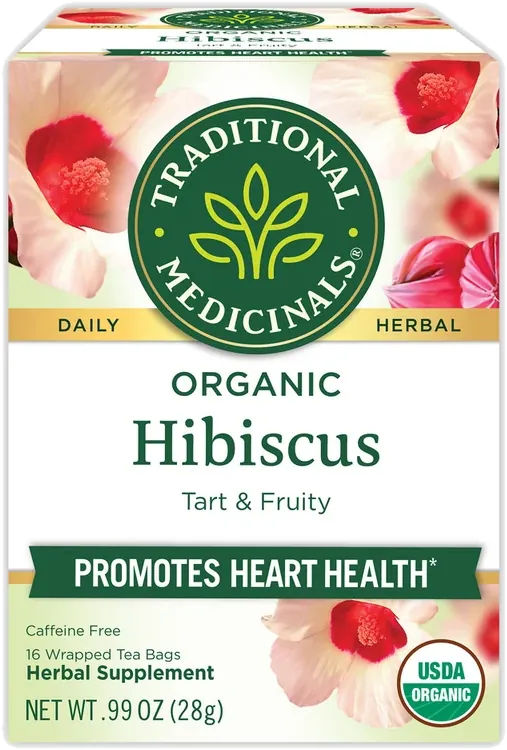
A tart, ruby-red cup of organic hibiscus with blackberry leaf and lemongrass: one bag, eight ounces of just-boiled water, five to ten minutes under a lid.
CHECK AVAILABILITYSold by WorldPantry.com, Inc., which runs the Traditional Medicinals online store · sixteen wrapped bags of organic hibiscus with blackberry leaf and lemongrass · replacement or refund within 90 days of a purchase on the store's website, shipping excluded
Back to the Red Kettle
It's late September as I finish this, and the cookout pitchers have gone back into cupboards up and down the street.
Mine hasn't, not yet.
The red kettle still makes coffee first thing, the way it always has.
Then it boils another round of water for the day's jug, and the saucer goes on the mug while I find my shoes for the walk.
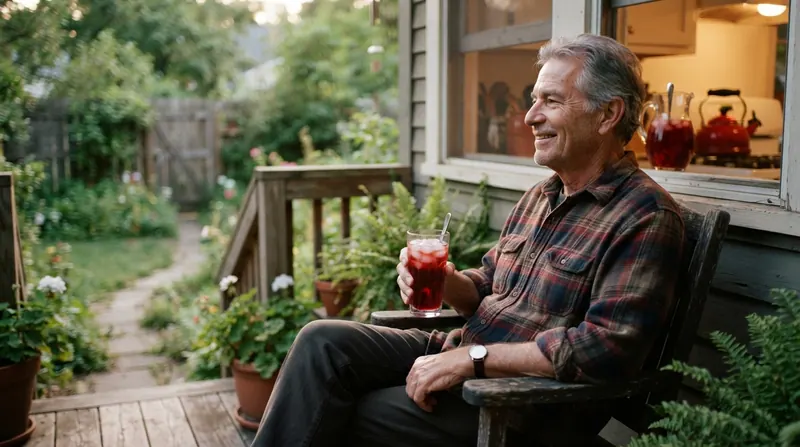
So where did this land? The drink is old, the tea bag is new, and the box is honest about what's in it.
One plant with its own number, two plants for flavor, no caffeine and no calories.
The research on hibiscus is small, and most of it is chemistry.
It tells you how the red gets into the cup, not what the cup will do, and I've tried to keep it that way.
Is it worth $7.49 to find out? For a cold, tart, unsweetened glass at three o'clock, I think it's a fair price for the question.
And with 90 days to ask for a refund, the question costs very little.
The kettle makes the tea. The pitcher makes it a habit.
If you decide to try a box, you now know how to brew it both ways, and exactly what each glass holds.
If you decide not to, the water, the walk and the vegetables are still on the list, and they don't cost a thing.
Either way, I hope your three o'clock glass is cold this week.
And I hope it's something you'd pick even if nobody told you to.
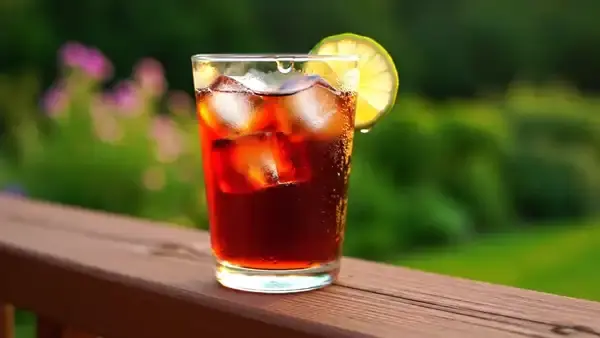
Sold and shipped by WorldPantry.com, Inc. for Traditional Medicinals. The price and any promotion are set by the store.
Both lines of the panel, the hibiscus with its weight and the blackberry leaf and lemongrass blend, are written out in the ingredient guide linked at the foot of this page.
The guide also covers the drinks, foods and everyday habits around the tea, and the one question worth asking your pharmacist.